Passports Are No Longer Just Travel Documents: Why They Are the Most Critical “Strategic Asset” for Global Ultra-High-Net-Worth Families
Introduction: The Value of “Option Value” in Global Turmoil
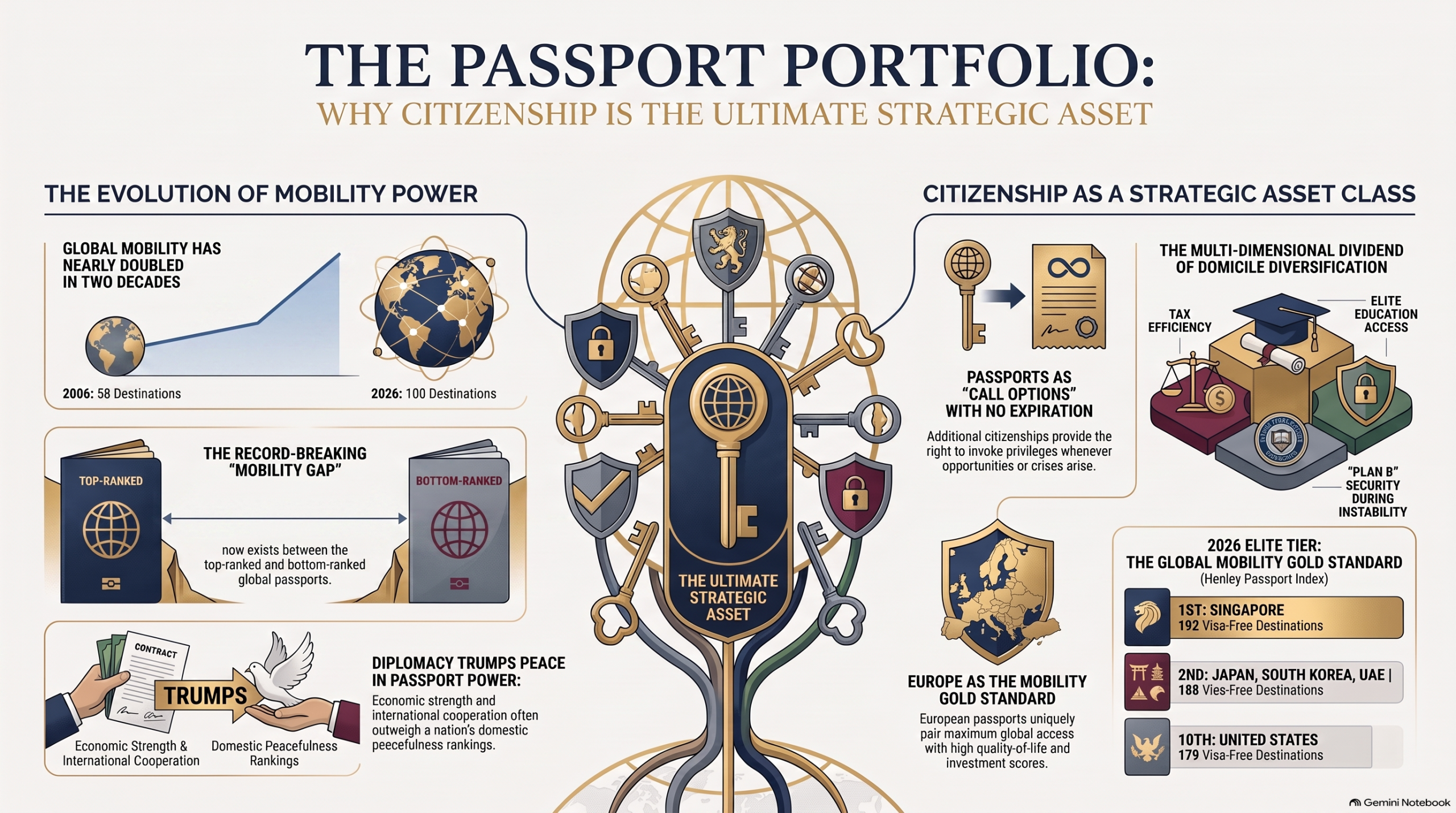
Against a backdrop of global geopolitical conflicts reaching their highest point since World War II and the Global Peace Index (GPI) declining for 12 consecutive years, a seemingly paradoxical phenomenon is occurring: global mobility is doubling. According to the 2026 Henley Passport Index (HPI) data, the global average number of visa-free destinations has jumped from 58 in 2006 to 108.
For Ultra-High-Net-Worth (UHNW) families, the fundamental nature of a passport has undergone a structural evolution. It is no longer merely a “travel document,” but a highly defensive “strategic asset class” within an asset portfolio. In an uncertain geopolitical landscape, a passport represents “downside protection”—determining a family’s safe-haven capabilities during crises, the flexibility of their tax planning, and their cross-generational freedom of choice.
Key Insight 1: Diplomatic Capital Trumps Peace Metrics — The Geopolitical “Asset Premium”
Traditional risk models often treat “domestic peace” as the indicator of mobility, but 2026 data reveals a profound shift: diplomatic capital and geopolitical influence contribute far more to a passport’s value than sheer levels of peace.
Israel (GPI rank 159) and the United States (GPI rank 134), despite placing near the bottom of the peace index, retain top-tier global passport strength. The most representative case is Ukraine: although its peace index ranks 160th globally due to conflict, its passport mobility ranks 31st. This proves that “geopolitical alignment” and “international recognition” generate a powerful mobility premium, sustaining asset liquidity even in conflict environments.
“Two decades of data show that passport strength is one of the clearest expressions of a nation’s geopolitical capital. It reflects far more than peace or prosperity. The world’s most powerful passports belong to nations that others actively seek to partner with—in trade, investment, security, or cooperation. Mobility is ultimately a measure of how much other countries value their relationship with you.”
Key Insight 2: The Rise of the UAE — A 20-Year Mobility Superpower
The performance of the United Arab Emirates (UAE) represents the most successful strategic case in global mobility research over the past two decades. Since 2006, the UAE passport has added an astounding 153 visa-free destinations, leaping to 2nd globally in 2026 (tied with Japan and South Korea) with 188 visa-free destinations.
The UAE’s successful “strategic mix” offers valuable lessons for family offices:
- Proactive Diplomatic Engagement: Consistently treating bilateral visa-waiver agreements as a diplomatic core.
- Aviation Connectivity Linked to Diplomatic Bargaining: Leveraging its status as a global aviation hub to convert access rights into diplomatic leverage.
- National Competitiveness Integration: Treating mobility as essential “infrastructure” to attract global talent and capital.
Key Insight 3: Europe’s “Structural Advantage” — The Gold Standard of Total Asset Quality
When analyzing passport assets, one must distinguish between “pure mobility” and “total asset value.” According to the Global Passport Index by Global Citizen Solutions (GCS), Sweden has held the top spot for three consecutive years. Unlike the HPI, which measures only visa-free counts, the GCS index integrates investment attractiveness and quality of life.
Europe’s passport advantage lies in its “Structural Alpha”:
- The Schengen Premium: The expansion of the Schengen Area to 29 countries creates the world’s only cross-border network for free living and working.
- Balanced Assets: While Singapore ranks first in “pure mobility,” European nations like Sweden offer greater advantages in balancing investment climate and quality of life.
As Global Citizen Solutions CEO Patricia Casaburi notes, Europe combines maximized mobility with a “quality of life that governments cannot simply create through treaties or tax incentives”—the core, most irreplaceable value of a passport as an asset.
Key Insight 4: The Relative Decline of the Atlantic Alliance vs. Asian Resilience
Comparing data from 2006 and 2026 reveals that the influence of traditional Atlantic powers is waning, while Asian leaders demonstrate remarkable resilience.
Henley Passport Index (Mobility Dimension) Comparison: 2006 vs. 2026
| Country / Region | 2006 Rank (Visa-Free) | 2026 Rank (Visa-Free) | Trend Analysis |
|---|---|---|---|
| Singapore | Rank 8 (122) | Rank 1 (192) | The new global mobility powerhouse |
| Japan / South Korea | Top 10 | Rank 2 (188) | Consistently holding top-tier status |
| United Kingdom | Rank 3 | Rank 7 (182) | Post-Brexit “isolation traits” emerging |
| United States | Rank 1 (130) | Rank 10 (179) | Dropped to a historical low, constrained by reciprocity policies |
Special Insight: Although the UK maintains high scores for quality of life, its sub-ranking for mobility in the GCS index has fallen to 30th. This is viewed as the “Brexit Signature,” reflecting how political isolation erodes citizens’ cross-border settlement rights and freedom of establishment.
Key Insight 5: The Mobility Divide — Structural Risk of the Global “Invisible Wall”
Despite improvements in average global mobility, the “mobility gap” has reached a record high. A 170-destination gap exists between Singapore (192 destinations) and Afghanistan (22 destinations).
An even more alarming statistic: Only 38.5% of bilateral global relationships feature reciprocal visa waivers (symmetry). This indicates that the global mobility network is fundamentally a “closed system” with rising barrier entries for non-member states. This structural inequality explains why leading family offices are accelerating “investment migration” to acquire tickets into this closed system.
Passports as Assets: Strategic Takeaways for UHNW Families and Family Offices
In today’s fragmented world, family offices should integrate “second residency” or “alternative citizenship” into their core asset allocation strategies, fulfilling five key functions:
- Quality of Life & Environmental Security: Accessing irreplaceable, high-quality healthcare, legal environments, and safe living spaces.
- Safe Haven Function: Providing an immediate evacuation path during systemic risks or sudden policy shifts in the home country.
- Securing Global Educational Resources: Utilizing residency rights to lower admission barriers to top-tier universities and gain structural advantages for local employment.
- Tax Planning Flexibility: Legal identity diversification is the cornerstone for optimizing global asset allocation and estate planning.
- Cross-Generational Mobility Protection: Preserving “freedom of choice” for future generations to avoid geopolitical constraints tied to a single nationality.
Conclusion: Wealth is Defined as “Freedom of Choice”
Reflecting on two decades of data evolution reveals a profound shift in how wealth is defined. True wealth is no longer measured solely by the scale of financial assets, but by the “freedom of choice regarding where to live, work, study, and belong.”
In an era of geopolitical fragmentation, is your family’s mobility portfolio sufficiently diversified? Has your “passport asset” undergone the same rigorous stress testing as your financial portfolio?
Professional Practice Key Learnings for Family Offices
- Conduct Deep “Corridor” Audits: Avoid blindly chasing total visa-free counts. Audit access and residency rights every 24 months based on core family business hubs, potential overseas study destinations for children, and asset location centers.
- Distinguish “Access Rights” from “Settlement Rights”: Powerful passports (like Singapore) offer travel convenience, but European programs (like Sweden or Switzerland) provide a combination of “quality of life + settlement options” that hold greater structural value for long-term wealth preservation.
- Deploy “Alternative Hedging”: Given that only 38.5% of global bilateral relationships are symmetrical, single nationality is now the ultimate systemic risk. Acquiring multiple identities through investment migration (e.g., programs in Malta, the UAE) has become standard risk-management procedure for modern family offices.
護照不再只是旅遊證件:為什麼它是全球高淨值家庭最關鍵的「策略性資產」?
引言:全球動盪中的「選擇權」價值
在全球地緣政治衝突達到第二次世界大戰以來最高點、全球和平指數(GPI)連續 12 年下降的背景下,一個看似矛盾的現象正在發生:全球移動性(Global Mobility)反而呈現翻倍增長。根據 2026 年恒理護照指數(Henley Passport Index, HPI)數據,全球平均免簽目的地已從 2006 年的 58 個躍升至 108 個。
對於超高淨值(UHNW)家庭而言,護照的本質已發生結構性演變:它不再僅是一張「旅行文件」,而是資產組合中具備高度防禦性的「策略性資產類別」。在充滿不確定性的地緣政治版圖中,護照代表的是一種「下行風險保護」(Downside Protection),決定了一個家庭在危機時刻的避險能力、稅務規劃的靈活性,以及跨代發展的選擇權。
關鍵洞察一:外交資本重於和平指標——地緣政治的「資產溢價」
傳統風險模型常將「國內和平」視為移動力的指標,但 2026 年的數據揭示了一個深刻的轉變:外交資本與地緣政治影響力對護照價值的貢獻,已遠超單純的和平程度。
以色列(GPI 第 159 名)與美國(GPI 第 134 名)即便處於和平指數末段,其護照實力依然穩居全球頂尖。最具代表性的案例是 烏克蘭:儘管其和平指數因衝突位列全球第 160 名,但其護照移動力卻位居全球第 31 名。這證明了「地緣政治結盟」與「國際認可」能產生強大的移動力溢價,即便在衝突環境下,外交資本仍能維持資產的流動性。
「二十年的數據顯示,護照實力是國家地緣政治資本最清晰的表達方式之一。它反映的不僅僅是和平或繁榮。世界上最強大的護照屬於那些其他國家渴望與之建立夥伴關係(貿易、投資、安全或合作)的國家。移動力歸根結底是衡量他國對你關係價值的指標。」
關鍵洞察二:阿聯酋(UAE)的崛起——20 年來的移動力超級強國
阿聯酋的表現是過去二十年全球移動性研究中最成功的戰略案例。自 2006 年以來,阿聯酋護照增加了驚人的 153 個免簽目的地,2026 年已躍居全球第 2 名(與日、韓並列),免簽目的地達 188 個。
阿聯酋成功的「策略組合」值得家族辦公室借鑒:
- 積極的外交參與:持續將雙邊免簽協議作為外交核心。
- 航空連接性與外交協商的聯動:利用其全球航空樞紐地位,將通行權轉化為外交談判籌碼。
- 國家競爭力集成:將移動力視為吸引全球人才與資本的「基礎設施」。
關鍵洞察三:歐洲的「結構性優勢」——總體資產質量的黃金標準
在分析護照資產時,必須區分「單純移動力」與「總體資產價值」。根據 Global Citizen Solutions (GCS) 的「全球護照指數」,瑞典已連續三年蟬聯榜首。與僅衡量免簽數量的 HPI 不同,GCS 指數綜合了投資吸引力與生活品質。
歐洲護照的優勢在於其「結構性阿爾法」(Structural Alpha):
- 申根區溢價:申根區擴張至 29 國,創造了全球唯一的跨國界自由生活與工作網絡。
- 平衡型資產:新加坡雖在「純移動力」排名第一,但瑞典等歐洲國家在「投資環境」與「生活質量」的平衡上更具優勢。
Global Citizen Solutions 執行長 Patricia Casaburi 指出:歐洲結合了最大化的移動力與那種「政府無法透過條約或稅務優惠創造的生活品質」,這是護照作為資產最難被複製的核心價值。
關鍵洞察四:大西洋聯盟的相對式微與亞洲勢力的穩健
對比 2006 年與 2026 年的數據,傳統大西洋強權的影響力正在消退,而亞洲領袖則展現了極強的韌性。
Henley 護照指數(移動力維度)2006 vs 2026 比較
| 國家 / 地區 | 2006 年排名 (免簽數) | 2026 年排名 (免簽數) | 趨勢分析 |
|---|---|---|---|
| 新加坡 | 第 8 名 (122) | 第 1 名 (192) | 全球移動力新霸主 |
| 日本 / 韓國 | 前十名 | 第 2 名 (188) | 持續穩居第一梯隊 |
| 英國 | 第 3 名 | 第 7 名 (182) | 脫歐後的「孤立特徵」顯現 |
| 美國 | 第 1 名 (130) | 第 10 名 (179) | 跌至歷史低位,受制於互惠政策 |
關鍵洞察五:移動力鴻溝——全球性「隱形牆」的結構性風險
儘管全球平均移動性提升,但「移動性鴻溝」卻創下歷史紀錄。新加坡(192 個目的地)與阿富汗(22 個目的地)之間存在高達 170 個目的地 的差距。
更具警示意義的數據是:全球僅有 38.5% 的雙邊關係具備對等免簽(Symmetry)。這意味著全球移動網絡本質上是一個「封閉系統」,對於非成員國而言,進入門檻正不斷提高。這種結構性不平等,解釋了為什麼領先的家族辦公室正加速透過「投資移民」來獲取進入這套封閉系統的「門票」。
護照作為資產:對高淨值家庭與家族辦公室的策略啟示
在當前破碎化的世界中,我們建議家族辦公室應將「第二居留權」或「替代公民身份」納入核心資產配置,其具備以下五大戰略功能:
- 品質生活與環境安全:獲取不可複製的優質醫療、法治環境與安全生活空間。
- 安全港(避風港)功能:在母國發生系統性風險或政策轉向時,提供即時的撤離路徑。
- 全球教育資源鎖定:利用居住權降低入讀頂尖名校的門檻,並獲取在地就業的結構性優勢。
- 稅務規劃靈活性:合法的身分多元化是優化全球資產配置與遺產規劃的基石。
- 跨代流動性保障:為家族後代儲備「選擇的自由」,避免單一國籍帶來的地緣政治限制。
結論:財富的定義是「選擇的自由」
回顧過去二十年的數據演變,我們可以看到財富的定義已發生深刻位移。真正的財富不再僅由金融資產的規模定義,而是由「居住、工作、學習與歸屬地的選擇權」來定義。
在這個地緣政治碎片化的時代,您家庭的「移動力組合」是否足夠多元?您的「護照資產」是否像您的金融組合一樣,經歷了嚴謹的壓力測試?
專業實務學習總結 (Key Learnings for Family Offices)
- 執行「移動廊道」(Corridor)深度審計:不應盲目追求免簽總數,應針對家族業務核心區、子女潛在留學地及資產存放地,每 24 個月進行一次通行權與居留權審核。
- 區分「通行權」與「定居權」:強大的護照(如新加坡)提供通行便利,但歐洲計畫(如瑞典、瑞士)提供的「生活質量+定居選擇」在長期財富保值中更具結構性價值。
- 佈局「替代性對沖」:鑑於全球雙邊關係僅 38.5% 對等,單一國籍已成為最大的系統性風險。透過投資移民(如馬耳他、阿聯酋等計畫)獲取多重身分,是現代家族避險的標準配置。